IWTRC2025 Report
Alwin Andriel L. Bathan
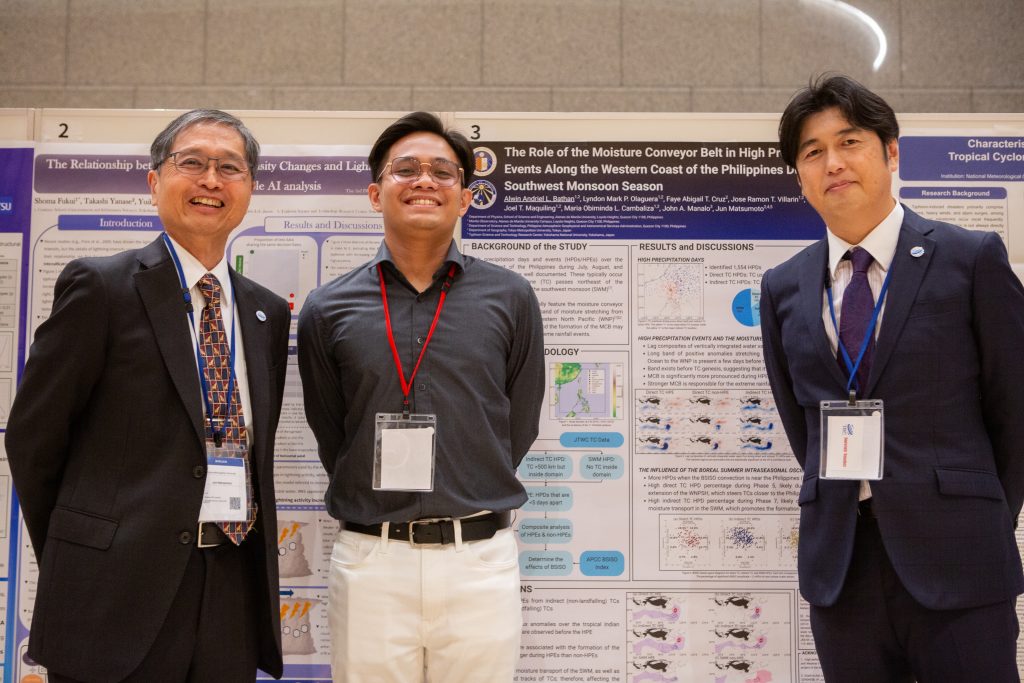
Attending this year’s International Workshop on Typhoon Science and Technology Research Center (IWTRC) was an unforgettable experience for me. I’m still fairly new to attending international conferences but I can confidently say that IWTRC 2025 is one of my favorites so far. I will forever be grateful for the travel and accommodation support, as well as the daily allowance, generously provided to me by the organizers. This made it possible for me to not only experience the talks and programs of IWTRC 2025, but to also experience Japan for the first time in my life. As someone who’s just starting his journey as a scientist, the talks helped me deepen my knowledge about tropical cyclones. All the talks were very informative and interesting. Not a single moment felt dull. The poster session was also a great opportunity to meet other scientists and learn more about their research.
I would like to thank Fudeyasu-sensei for making all of this possible. From the financial support he offered to me, to the knowledge he shared throughout the event. It was an honor to meet him in person and I really felt his dedication, effort, and hospitality during the entire event. I would also like to thank Ms. Kikkawa Harue for assisting me in the travel process, answering my emails, and for being such a kind and warm presence.
It was also great to finally see some well-known scientists in person, especially Prof. Johnny Chan and Prof. Suzana Camargo. Before this event, they were all just names on papers to me, so it’s great to actually see them in real life. It was inspiring to hear them share their knowledge and talk about their expertise firsthand. I jokingly said to my friends who also attended the workshop “Wow, those guys are all-stars…they’re the Avengers”, since I was just so shocked to be in the same room with them.
Special thanks to Matsumoto-sensei, who is a co-author of some of my works and also a big part of IWTRC 2025. Before this event, I didn’t even know what he looked like. It wasn’t until he came up to me while I was putting up my poster, pointed to his name, and said, “That’s me,” that I finally got to meet him. I’ll never forget that funny little exchange since it’s such a memorable way for us to have met.
Thank you to everyone who made this workshop possible. I will forever cherish the memories I made during this event. I hope to have the opportunity to attend and participate in the future IWTRCs.
Alwin Andriel L. Bathan
Master’s student in Atmospheric Science, Ateneo de Manila University
Research Assistant, Manila Observator
Rafaela Jane P. Delfino
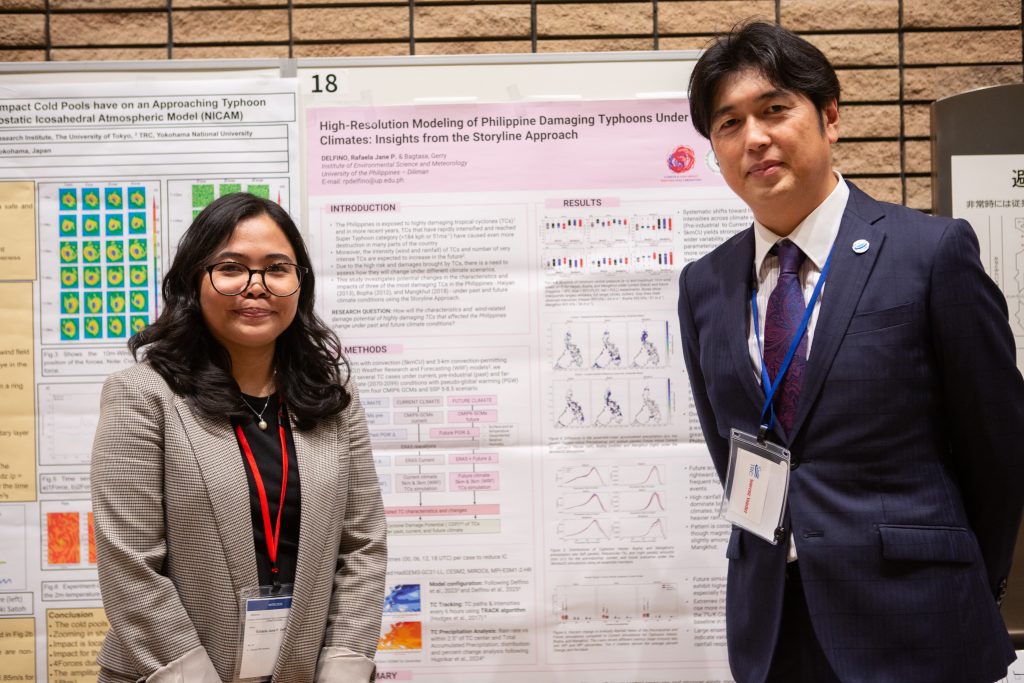
The International Workshop on Typhoon Science and Technology Research (IWTRC) 2025, organized by the Typhoon Science and Technology Research Center (TRC) of Yokohama National University (YNU), convened scientists, students, and policymakers to discuss advances in typhoon science, modeling, and disaster risk reduction.
The two-day workshop served as an international platform for exchanging the latest scientific findings in tropical cyclone observation, modeling, and impact mitigation. Researchers from Japan, Southeast Asia, and Europe presented studies on high-resolution simulations, data assimilation, air–sea interactions, and the influence of climate change on typhoon intensity and structure. Sessions emphasized the integration of physical science with early-warning systems and policy applications.
On the 3rd day, we visited the Japan Meteorological Agency’s Yokohama Local Meteorological Office (YLMO). The excursion provided insights into Japan’s operational forecasting workflow, real-time monitoring, and multi-level disaster communication. This model of localized risk dissemination offers relevant lessons for improving community-based early-warning systems in the Philippines. In the public symposium held in the afternoon, researchers introduced Japan’s “TyphoonShot” initiative under the Moonshot Program. Discussions explored the scientific feasibility and ethical implications of deliberate typhoon modification, emphasizing transparency, interdisciplinary collaboration, and regional cooperation in advancing such frontier research.
The IWTRC 2025 emphasized the increasing need for interdisciplinary and collaborative approaches in typhoon research. Japan’s TRC demonstrates how strong government–academic–industry linkages and innovation-driven funding mechanisms can accelerate scientific and operational advances. The workshop also showcased opportunities for regional cooperation between TRC and Philippine institutions, particularly in improving tropical cyclone predictability, risk communication, and climate adaptation strategies.
I was able to present our research using high resolution model simulations to investigate three highly damaging Philippine typhoons under different climate conditions. My participation was supported by the Typhoon Science and Technology Research Center, Yokohama National University.
Dr. Rafaela Jane P.Delfino
Institute of Environmental Science and Meteorology
University of the Philippines – Diliman
Shao-Yu Tseng
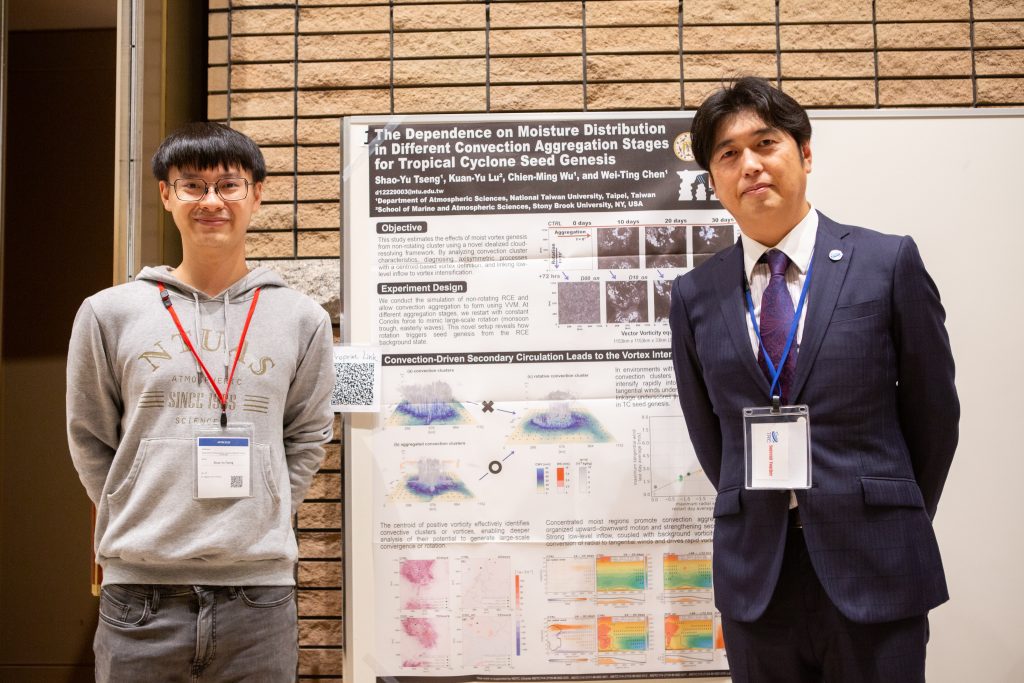
I would like to express my sincere gratitude to the staff and faculty of Yokohama National University who organized the 3rd IWCRT and gave me the opportunity to present my first research work on tropical cyclone seed genesis.
In my poster presentation, I introduced results from an idealized cloud-resolving model that examine how different convective clusters influence the development of moist vortices. The simulations show that, compared with scattered convective clusters, more aggregated convection generates a stronger horizontal contrast between dry and moist regions. Convection preferentially develops within the moist area, establishing a coherent secondary circulation. The enhanced low-level inflow more efficiently converges background vorticity, leading to a faster formation of an organized moist vortex. I am grateful that IWTRC provided a platform for me to discuss these findings with the typhoon research community. I received valuable suggestions regarding scientific interpretation, including how these idealized experiments compare with more complex global storm-resolving models and how observational evidence may help validate the proposed mechanisms.
The workshop covered a broad spectrum of typhoon-related topics—from airborne observations and detailed case studies to projections of future changes in typhoon frequency and intensity. I was also impressed by the discussions on the scientific background of the TYPHOONSHOT project, which aims to explore possible future strategies for controlling typhoons or extracting their energy.
I also deeply appreciate the organizers for arranging a visit to the Yokohama Local Meteorological Office. The visit provided valuable insights into the history of station relocation, the traditional instruments used to measure temperature, pressure, and humidity, as well as the modern operational instruments currently in use. It was also informative to learn about the station’s role in monitoring local weather conditions and managing the warning system for the entire Kanagawa region. This experience helped me better understand both the differences and similarities between meteorological operations in Japan and Taiwan.
Overall, participating in the 3rd IWTRC was an invaluable experience that broadened my scientific perspective, strengthened my connections with the typhoon research community, and inspired future directions for my work. I look forward to applying what I have learned to further advance my research on tropical cyclone genesis and development.
Shao-Yu Tseng
Ph.D. Student
Department of Atmospheric Sciences, National Taiwan University
Yining Gu

My participation in the 3rd International Workshop organized by the Typhoon Research Centre (TRC) in Yokohama this October was an incredibly enriching and unforgettable experience. I am profoundly grateful for the opportunity, made possible by the generous financial support from the TRC. I would like to extend my sincere appreciation to Professor Hironori Fudeyasu for his leadership in organizing such a stimulating event. A special note of thanks must also go to the secretariat, especially Ms. Kikkawa Harue, whose meticulous assistance and kindness were instrumental in ensuring my trip was smooth and hassle-free from start to finish. The workshop was a tremendous platform for learning and exchange. I had the privilege of presenting a poster on the influence of Madden-Julian Oscillation
diversity on multiple tropical cyclones, which sparked many insightful conversations. I am particularly grateful to Professor Tetsuo Nakazawa, who graciously provided me with invaluable advice and guidance on my research, offering a fresh perspective that I will certainly incorporate into my future work. Furthermore, the welcome reception was a delightful occasion, allowing me to engage in warm and friendly discussions with professors and peers from around the world about tropical cyclones over Yokohama’s delicious local cuisine. These interactions broadened my academic horizons and fostered potential future collaborations. A particular highlight was the special visit to the Yokohama Local Meteorological Office. The staff patiently and meticulously explained the local meteorological instruments and the history of weather forecasting in Japan. It was fascinating to see
the evolution of technology and gain a deeper, practical understanding of Japan’s meteorological operations. In conclusion, this workshop was far more than an academic conference. It was a
holistic cultural and intellectual journey. The knowledge gained, the constructive feedback received, and the new connections forged have left a lasting impression on me. This experience has significantly motivated me to advance my research. I sincerely hope to have the opportunity to participate again in the future and to contribute further to this vibrant scientific community. Thank you again to everyone at the TRC for this invaluable.
Yining Gu
Fudan University
Ishini Tecla Warnasooriya

I would like to express my heartfelt gratitude to the Typhoon Science and Technology Research Center (TRC) and Yokohama National University for granting me the travel support scholarship and giving me the opportunity to participate in the International Workshop of the Typhoon Science and Technology Research Center (IWTRC 2025). My sincere thanks also go to Professor Hironori Fudeyasu, Professor Masaki Satoh, Professor Jun Matsumoto, Ms. Harue Kikkawa and the entire organizing committee for their warm hospitality and excellent coordination throughout the event.
This was my first international conference experience, and it was truly an inspiring and eye-opening opportunity. As a student from a computer science background, participating in a workshop focused on typhoon science introduced me to new concepts, methodologies, and global research perspectives related to meteorology and climate science. The lectures and presentations were highly informative, and I was deeply impressed by the diversity of research shared by participants from different countries.
The poster session was a particularly memorable part of the workshop. Presenting my research and discussing it with distinguished professors, researchers, and fellow students was both exciting and rewarding. The valuable feedback and encouragement I received have motivated me to further improve my work and explore new research directions.
Beyond the academic sessions, the excursion to the Yokohama Local Meteorological Office and the opportunity to meet professionals working in the field were enriching experiences. I gained a better understanding of how scientific research connects with real-world applications in weather forecasting and disaster management.
I am truly grateful for the support, learning, and cultural exchange that this workshop provided. My sincere appreciation once again to Professor Fudeyasu, Ms. Kikkawa, and all the members of the TRC and Yokohama National University for organizing such a wonderful event. The IWTRC 2025 has been an unforgettable milestone in my academic journey, and I hope to continue contributing to research in this field in the future.
Ishini Tecla Warnasooriya
Sri Lanka Institute of Information Technology (SLIIT)